Overview
Why garage floors in New Berlin wear out so quickly
Ask anyone who has lived through a few Wisconsin winters what their garage floor looks like by March, and you will hear the same description: a grey film of dried salt, a damp patch where the car drips, and a few spots near the door where the surface has started to flake away. Bare concrete is porous, and in a cold climate that porosity works against it.
Each time you pull in after driving on treated roads, slush packed into the wheel wells melts and runs across the slab. The salty water soaks into the surface, and when temperatures drop overnight, whatever is left in those pores freezes and expands. Repeat that a few dozen times a season and the top layer of the concrete starts to scale and pit. Add oil drips, antifreeze, lawn chemicals and the occasional dropped tool, and you have a floor that ages much faster than the rest of the house.
A professionally installed garage floor coating changes that equation. Once the concrete is ground, repaired and sealed under a bonded coating system, meltwater stays on the surface where it can be pushed out the door with a squeegee. Stains wipe up instead of soaking in. The floor brightens the whole room, makes the garage feel like part of the home, and protects the slab you paid for when the house was built.
We install garage floor coatings throughout New Berlin, from older neighborhoods near Cleveland Avenue and Greenfield Avenue to newer subdivisions on the city's west side, and in nearby Brookfield, Muskego, Waukesha and Elm Grove. Most projects are finished in one or two working days.
The coating you see is the last ten percent of the job. The grinding, repairs and moisture checks underneath are what decide how the floor looks in five winters.
Benefits
What changes once the garage is coated
Homeowners usually call us because the old floor looks tired. The reasons they end up loving the new one tend to be more practical.
Winter cleanup in minutes
Salt slush sits on top of a sealed floor. A squeegee and a few minutes is often all it takes to push it out the door during a storm.
Protection against scaling
Keeping brine out of the concrete removes the main ingredient in freeze–thaw pitting and surface flaking near garage doors.
Stain resistance
Oil, transmission fluid, fertilizer and paint drips stay on the surface where they can be wiped away instead of leaving permanent marks.
Better footing when wet
Flake texture and slip-resistant additives in the topcoat give shoes more grip than a smooth, glossy surface would.
A brighter garage
Light-reflecting finishes make it easier to see what you are doing at the workbench and to find things on the floor.
A finished first impression
For many families the garage is the front door. A coated floor makes that daily entrance feel clean and deliberate.
Options & finishes
Garage coating systems and finishes
There is no single "garage epoxy." A complete system is built from layers — usually a primer or base coat that bonds to the concrete, a decorative or build layer, and a protective topcoat — and the products in each layer can be mixed and matched to suit the garage.
During the estimate we talk about how you use the space, whether the garage is heated, and how much texture and shine you like. Then we recommend one of the systems below, or a combination.
Applications
Garages we coat around New Berlin
Most of our garage work is in single-family homes, but the same systems serve anywhere vehicles, equipment and seasonal storage share a concrete floor.
Attached two- and three-car garages
The everyday entrance for most families, and the floor that takes the most salt.
Detached garages
Unheated buildings where timing and product choice matter more.
Garage workshops
Benches, tool chests and the spills that come with real projects.
Garage gyms
A clean, bright floor under mats, racks and cardio equipment.
Collector and hobby garages
Classic cars, motorcycles and show-ready spaces.
EV-ready garages
Newer homes and remodels where the garage is part of the design.
Installation
How we coat a garage floor
A typical two-car garage follows this sequence. Larger garages or floors that need more repair may take an extra day.
Clear and protect
You empty the garage floor; we protect drywall, doors and the threshold to the house, and set up dust collection.
Diamond grind the slab
Grinding removes sealers, weak surface paste and contamination so the base coat can bond into open concrete.
Repair cracks, pits and spalls
Damage is filled with repair material suited to the defect and ground flush. Control joints are addressed so the floor can still move.
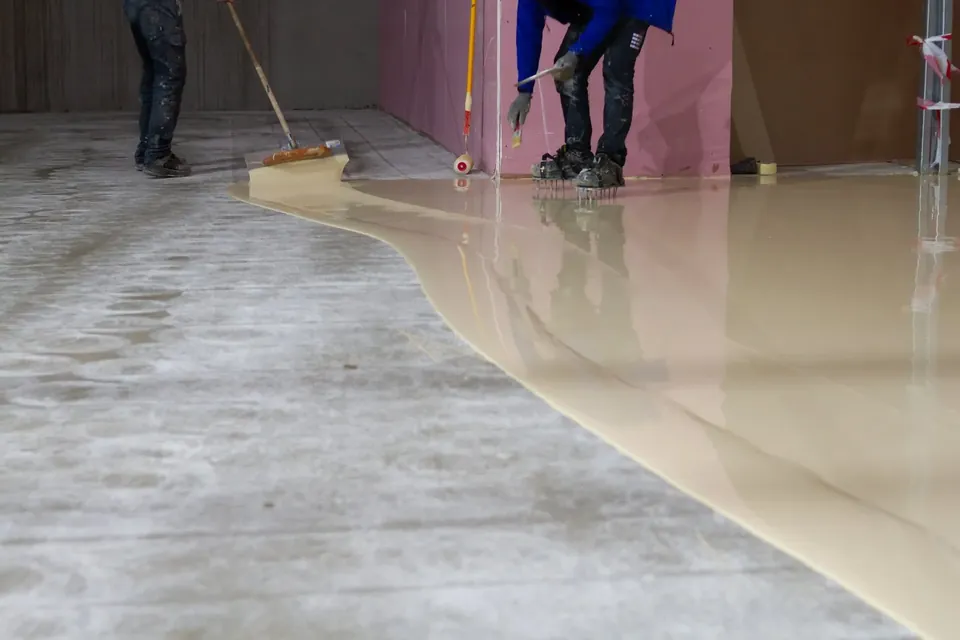
Lay down the base
The base goes down at the specified thickness, including up the face of the stem wall if that is part of your scope.
Chip broadcast, then knock-down
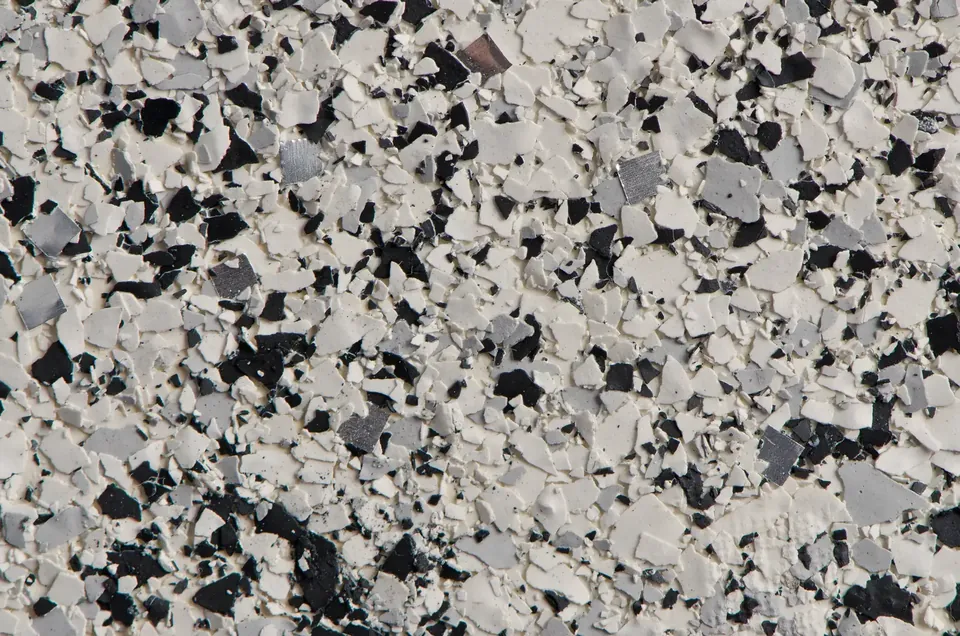
On flake floors, chips are thrown until the wet base will hold no more; once it hardens, the surface is scraped and vacuumed.
Topcoat and cure
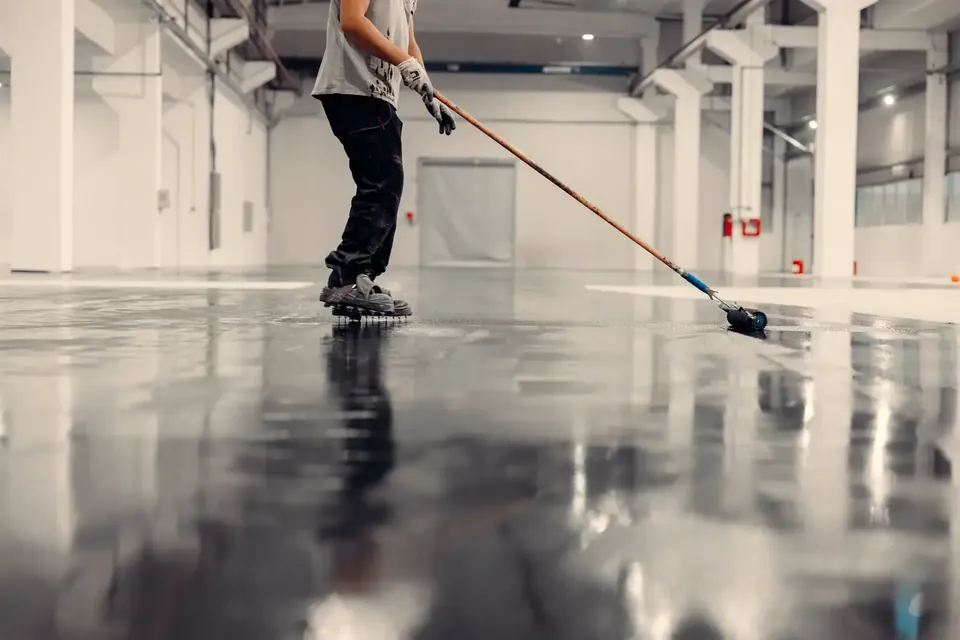
The clear topcoat seals the floor and sets the final texture. We go over walk-on and drive-on times before we leave.
Professional installation
Why professional installation matters on a garage floor
Store-bought garage kits are tempting, and we understand why. The trouble is that most rely on acid etching instead of grinding, use thin water-based epoxies, and are applied in a single afternoon without any repair work. In a climate like ours, the usual result is peeling in the tire paths within a season or two — sometimes sooner, when hot tires soften the coating and pull it off the floor.
Professional systems use 100-percent-solids or high-solids materials that are much thicker and harder than consumer products, applied over a mechanically prepared surface. Industrial grinders with dust extraction open the slab far more consistently than chemicals can. We also handle the details that are easy to miss: feathering repairs so they disappear, cutting crisp edges at the walls, and choosing a topcoat that won't yellow where sunlight hits the floor.
Just as important is knowing when not to coat. If a slab has a moisture problem, severe structural cracking, or a contaminant we can't remove, we will tell you before any work starts. A floor that looks great for one winter isn't worth much to either of us.
New Berlin & Wisconsin
Garage coatings for Wisconsin winters
Road salt is the reason so many New Berlin homeowners coat their garages, and it's the reason we put so much weight on texture and topcoat selection. A coated floor that is perfectly smooth can be slick when it is covered in meltwater, so we nearly always recommend a flake broadcast or slip-resistant additive for garages where cars come in wet.
Temperature affects the install too. Coatings need the slab and the air to be within the manufacturer's range to flow, bond and cure properly. Attached garages usually stay warm enough for much of the year; detached garages may need to wait for a milder stretch or be heated temporarily. Late summer and fall are popular because the floor can fully cure before salt season begins.
Once it is installed, winter care is simple: squeegee out standing slush when you can, rinse the floor occasionally to remove salt residue, and use a mat under the car if you like. Rinsing during a thaw keeps the finish looking its best into spring.
FAQ
Garage Floor Coatings: frequently asked questions
How soon can I park in the garage after it is coated?
With a polyaspartic topcoat, light foot traffic is often possible within several hours, and vehicle traffic generally follows after a day or more. Cooler temperatures slow curing, so we give you specific times for your floor and the conditions on install day rather than a blanket number.
Will hot tires lift the coating?
Hot-tire pickup is a common problem with thin DIY coatings that sit on top of unprepared concrete. Professional-grade materials applied over a ground slab are far more resistant, because the coating is thicker, harder and bonded into the surface rather than resting on it.
What has to be moved out before you start?
Everything sitting on the floor has to go, since we grind and coat right up to the walls. Items on wall shelves or hooks can usually stay if they are well above the floor. We are happy to talk through what needs to move when we schedule your install.
Can you coat over an existing garage epoxy?
Sometimes. If the old coating is well bonded, it can be ground and recoated. If it is peeling, flaking or bubbling anywhere, it generally needs to come off, because a new coating is only as secure as whatever it is attached to. We test adhesion during the estimate.
Should the coating go up the stem wall?
Many homeowners like a coated stem wall, the short concrete curb along the garage perimeter, because it cleans up the transition to drywall and protects the area where snow piles up. It is an optional part of the scope and we include it in your estimate if you want it.